
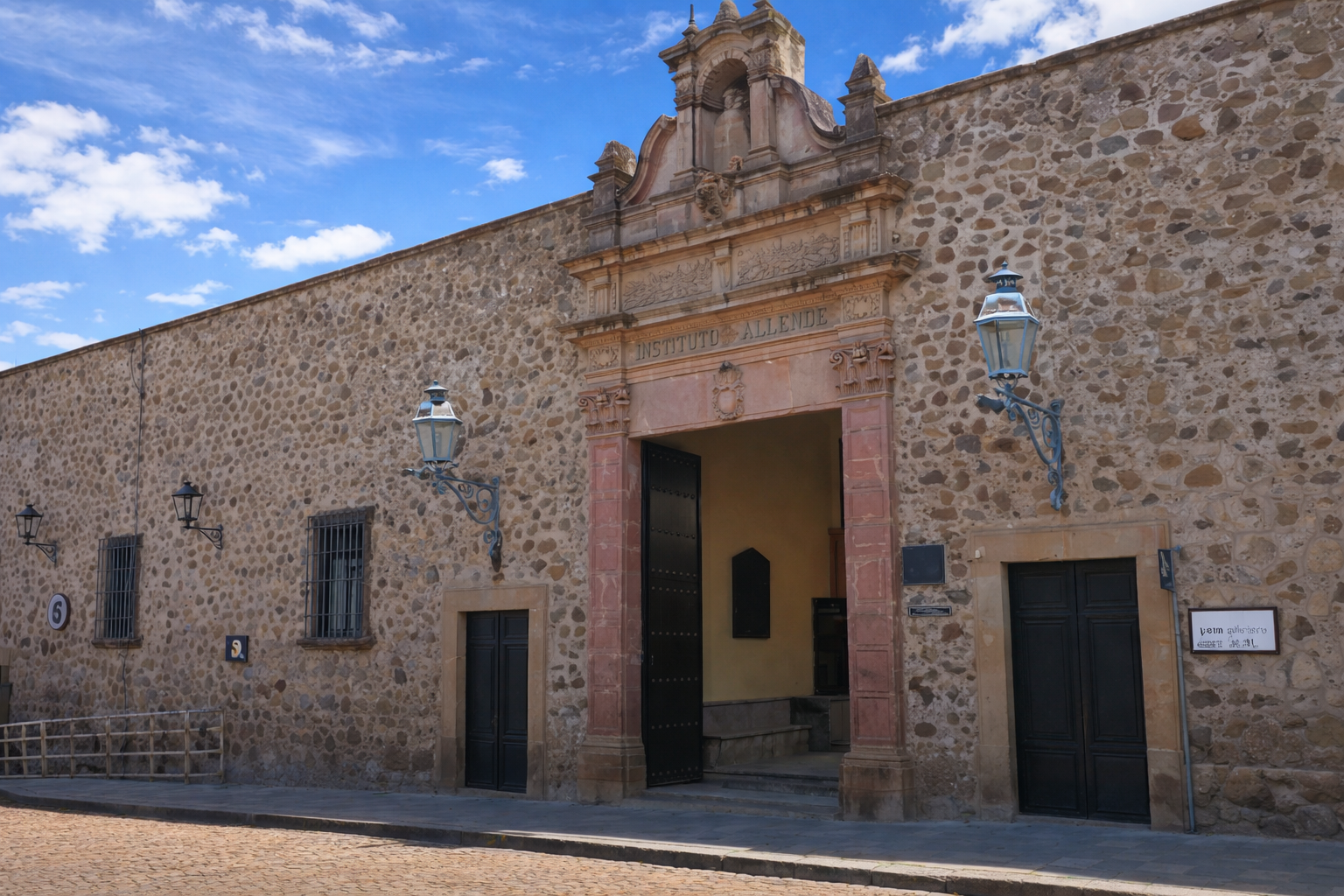
Before San Miguel de Allende was recognized as an international art center, before the contemporary galleries and the cultural prestige that surrounds it today, there was a place that sowed that vocation silently but decisively: the Instituto Allende.
To speak of the Instituto Allende is to speak of a foundational stage in the city's modern identity. A stage less visible than other symbols, but deeply influential. Without this space, San Miguel would hardly have developed the natural relationship it has today with art, creativity, and cultural exchange.
A visionary project
The Instituto Allende was founded in the 1950s, at a key moment for San Miguel de Allende. The city still retained a quiet life, with strong local roots, but began to attract the attention of foreign artists and creators looking for something different from the great cultural capitals.
Mainly artists, architects, and students from the United States and Canada arrived at the Instituto Allende interested in learning and creating art in an authentic environment, loaded with history, tradition, and a deeply Mexican aesthetic. They came not just to train technically; they came to live art from a real cultural context.
This exchange was much more than academic. It was human, daily, and transformative, both for those who arrived and for the local community.
The birth of a creative city
Thanks to the Instituto Allende, San Miguel began to consolidate as:
- A creative city, open to artistic experimentation.
- A space where art was not isolated in closed institutions, but integrated into daily life.
- An international meeting point where different cultural perspectives could coexist and dialogue.
Long before current gallery circuits existed, the Instituto Allende was already training artists, promoting exhibitions, organizing meetings, and, above all, creating community. It was one of the first solid bridges between San Miguel de Allende and the world.
Lasting influence
The influence of the Instituto Allende is not measured solely in names or generations of trained artists, but in something deeper: the transformation of the city's character.
Many of those who arrived as students decided to stay. Others returned to their countries carrying the San Miguel experience with them and sharing it in their own cultural circles. Thus, organically, the city began to be recognized internationally as a fertile place for artistic creation.
Thanks to this institution:
- San Miguel opened up to international cultural dialogue without losing its identity.
- The local art scene was strengthened, finding new forms of expression.
- A lifestyle was consolidated where art ceased to be an occasional event to become part of everyday life.
A silent, but essential influence
Unlike other more visible or media-friendly spaces, the Instituto Allende does not seek the spotlight. Its presence is discreet, almost introspective. However, its impact is structural.
It is one of those invisible roots that explain why San Miguel de Allende is not a recent phenomenon or a passing fad, but the result of decades of conscious cultural construction, based on exchange, openness, and respect for creation.
Living near history that is still alive
Living in San Miguel de Allende is, many times, living near stories that are not always told at first glance, but that continue to define the character of the city. The Instituto Allende represents precisely that: a story that does not need great spotlights to demonstrate its importance.
Its legacy remains present in the way San Miguel relates to art, to those who come from outside, and to the very idea of a creative community.
Understanding the Instituto Allende is understanding why San Miguel not only looks like an artistic city but thinks, lives, and expresses itself as such.